
THE $800 PORSCHE RIDE — WHEN INFLATION GETS LOADED ON A CAR HAULER
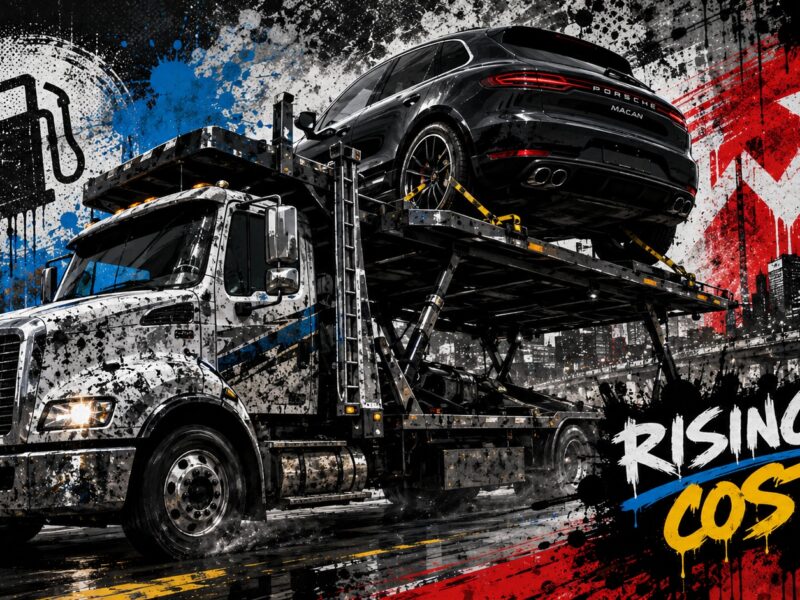
A 636-mile shipment, a $1.26-per-mile bill and the reason higher transportation costs eventually land in your driveway.
🚗 THE PORSCHE IS HEADED BACK TO COLORADO
My wife, Becky, has been driving a 2018 Porsche Macan S.
We decided to sell it to our son in Colorado and find a newer Macan for her.
Simple enough.
The Porsche needed to travel from El Paso, Texas, to Englewood, Colorado.
Distance: 636 miles
The transportation bill:
$800
That works out to:
$1.26 PER MILE
I have shipped vehicles all over the country for more than twenty years.
In something resembling a normal market, I would expect a route like this to cost somewhere around 65 to 75 cents per mile.
At 65 cents per mile, 636 miles would cost about $413.
At 75 cents per mile, it would cost about $477.
Instead, it cost $800.
That is approximately 68% to 94% more than the range I would normally expect.
The Porsche did not become heavier.
Colorado did not move farther away.
The truck did not suddenly become twice as luxurious.
The cost of moving it changed.
🛻 AND THAT WAS NOT MY ONLY TRANSPORTATION BILL
This same month, I paid another:
$1,400
That was to transport a Ford F-150 from Manheim, Pennsylvania, to Englewood, Colorado.
Two vehicle shipments.
One month.
$2,200 IN TRANSPORTATION COSTS
That money does not improve either vehicle.
- It does not add horsepower.
- It does not replace the tires.
- It does not repair a scratch.
- It simply gets the vehicles from where they are to where they need to be.
That is the automotive version of inflation.
You pay substantially more.
You receive essentially the same service.
🚛 DO NOT BLAME THE TRUCK DRIVER
I recently spoke with the owner of a dealership who was complaining to a transportation company about the cost of moving vehicles.
The transporter responded:
“Don’t blame me. My fuel costs have gone from $10,000 to $20,000 a month. The people creating this chaos are obviously asleep at the wheel.”
That is the part consumers often do not see.
The transportation company is not necessarily collecting twice as much profit.
It may simply be trying to survive costs that have exploded underneath the business.
- The truck requires diesel.
- The driver must be paid.
- The equipment must be purchased and maintained.
- Insurance must be carried.
- Tires must be replaced.
- Tolls must be paid.
- Permits, taxes and fees still arrive.
- The truck may return partially loaded—or empty.
The American Transportation Research Institute reported that the average cost to operate a truck reached a record $2.336 per mile in 2025. Even excluding fuel, operating costs rose to $1.854 per mile. Tolls increased 13.2%, repairs and maintenance rose 8.6%, driver benefits increased 6.6%, and tires rose 6.4%.
The carrier cannot absorb all of that.
The customer eventually receives the bill.
This time, the customer was me.
⛽ DIESEL DOES NOT STAY AT THE TRUCK STOP
On July 13, 2026, the national average price of on-highway diesel was $4.796 per gallon, more than one dollar higher than a year earlier. In the Rocky Mountain region, it averaged $4.60 per gallon. Those prices already include taxes.
Federal diesel taxes account for 24.4 cents per gallon, while state taxes and fees average roughly another 35.5 cents. That is nearly 60 cents per gallon before considering county or local charges that may also apply.
Then add the latest fighting involving the United States and Iran.
Oil prices climbed again as attacks and threats to shipping routes raised concerns about the movement of crude through the Middle East. Brent crude reached more than $91 per barrel and U.S. crude climbed above $85 on July 21.
Fuel does not become expensive in isolation.
Higher diesel costs move through the entire economy.
📦 EVERYTHING RIDES ON A TRUCK
- Cars ride on trucks.
- Food rides on trucks.
- Furniture rides on trucks.
- Appliances ride on trucks.
- Building materials ride on trucks.
- Auto parts ride on trucks.
- Medical supplies ride on trucks.
- Clothing rides on trucks.
- The products sitting inside stores arrived on trucks.
- The packages delivered to your house rode on trucks.
- The replacement part your mechanic ordered probably rode on several trucks before reaching the repair shop.
When it costs more to move everything, everything begins costing more.
- The trucking company charges the dealership.
- The dealership adds the cost to the vehicle.
- The parts distributor charges the repair shop.
- The repair shop adds the cost to the invoice.
- The grocery distributor charges the store.
- The store adds the cost to the groceries.
Eventually, the consumer pays.
YOU ALWAYS PAY.
The bill may not say diesel fuel, war, tolls, insurance, taxes or government policy.
It simply appears as a higher price.
🏛️ WASHINGTON DOES NOT HAVE TO WRITE THE CHECK
Government officials can approve spending, sanctions, regulations, taxes, military action and energy policies without personally receiving an $800 vehicle-transportation bill.
- They do not have to stand at an auction trying to calculate whether a vehicle still makes financial sense after adding transportation.
- They do not have to explain to a customer why a truck costs more before it ever reaches the dealership.
- They do not have to decide whether shipping a used Porsche 636 miles is still worth doing.
Consumers and business owners make those decisions.
The government does not create every cost inside the transportation industry.
But government decisions affect fuel, taxes, trade, regulation, interest rates, war, infrastructure and the operating environment in which every carrier must work.
- The long tail of COVID-era disruption did not help.
- Fuel taxes do not help.
- Toll roads do not help.
- Insurance increases do not help.
- Higher equipment and repair costs do not help.
- War-driven oil volatility certainly does not help.
And while politicians argue about whose fault it is, the truck still needs diesel.
🧮 APPARENTLY, BASIC MATH IS NOW CONTROVERSIAL
If the cost of moving goods increases, the cost of those goods increases.
If businesses pay more for fuel, insurance, labor, equipment, financing and tolls, they must charge more—or eventually close.
If the government makes energy and transportation more expensive, consumers will pay more for nearly everything transported.
This should not require an economics degree.
Apparently, the lawyers and professional political class in Washington failed basic math.
- You cannot repeatedly increase the cost of doing business and then act surprised when businesses increase their prices.
- You cannot create instability around the world’s energy supply and pretend it will not reach the American consumer.
- You cannot double a transporter’s fuel bill and expect him to continue charging yesterday’s rates.
The math always arrives.
This month, it arrived on two car haulers.
💵 THE SERVICE DID NOT BECOME BETTER
- The Macan still traveled 636 miles.
- The transporter picked it up.
- The transporter delivered it.
- That is the service.
The price went from what might normally have been around $413 to $477 to $800.
The service did not become 68% to 94% better.
The truck did not arrive with a marching band.
- Nobody detailed the Porsche.
- Nobody installed new tires.
- Nobody filled it with premium fuel.
The additional money paid for the rising cost of making the trip possible.
That is what inflation feels like outside a government report.
It is not a percentage flashed on television.
It is opening your wallet and paying $800 for something you remember costing roughly $450.
🌎 THIS IS BIGGER THAN ONE PORSCHE
It would be easy to dismiss this as the cost of shipping a Porsche.
But the brand of vehicle is not the point.
The same cost affects:
- A family relocating across the country.
- A soldier shipping a vehicle after receiving new orders.
- A student moving home.
- A dealer trying to stock affordable used cars.
- A collector buying something at an auction.
- A parent sending a vehicle to a child.
- A small business moving work trucks.
- A buyer who found the right vehicle several states away.
Every transportation increase changes the economics of the deal.
Sometimes the consumer pays more.
Sometimes the dealer makes less.
Sometimes the transaction simply does not happen.
🅿️ WHY THIS STORY IS PARKED ON CARSFREAK.COM
This is not merely a complaint about an $800 bill.
It is a real automotive story about what it currently costs to move vehicles across America.
- The Porsche is real.
- The distance is real.
- The transportation bill is real.
- The F-150 shipment is real.
- The pressure on transportation companies is real.
And the consumer standing at the end of the line is always real.
CarsFreak.com was built for more than vehicles offered for sale.
It is also a place for:
- Automotive businesses.
- Transportation companies.
- Dealership experiences.
- Buying stories.
- Selling stories.
- Industry warnings.
- Cost comparisons.
- Opinions.
And real-world experiences that help explain what is happening throughout the automotive economy.
THE PORSCHE COST $800 TO TRAVEL 636 MILES.
THAT IS $1.26 PER MILE.
AND YOU ARE PAYING THE SAME INFLATION EVERYWHERE ELSE—EVEN WHEN YOU CANNOT SEE THE TRUCK.
⭐ WHY THIS PARKING SPOT WORKS
Look beneath the two embedded videos at the bottom of this advertisement.
The public counter shows that this Parking Spot has been viewed X number of times.
That counter will keep clicking.
This is one car-related story on CarsFreak.com.
It can be updated, improved and shared again without losing the attention it has already accumulated.
And creating a full-page Parking Spot like this costs:
ONE FULL-PAGE PARKING SPOT — $7
AFFILIATE PROGRAM — FREE TO JOIN
The fact that you are reading it is part of the demonstration.