
Uber Replaced the Taxi Dispatcher. Now Robotaxis Want to Replace the Driver. Who Gets Paid?
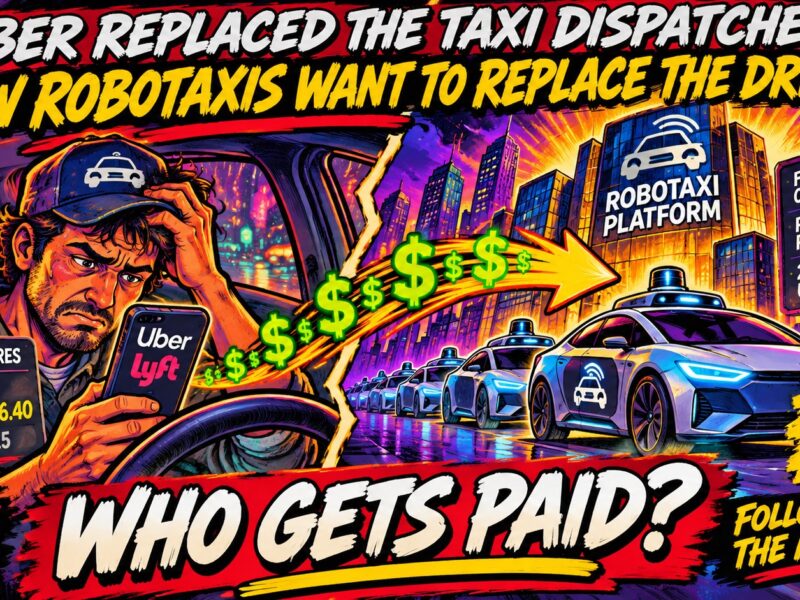
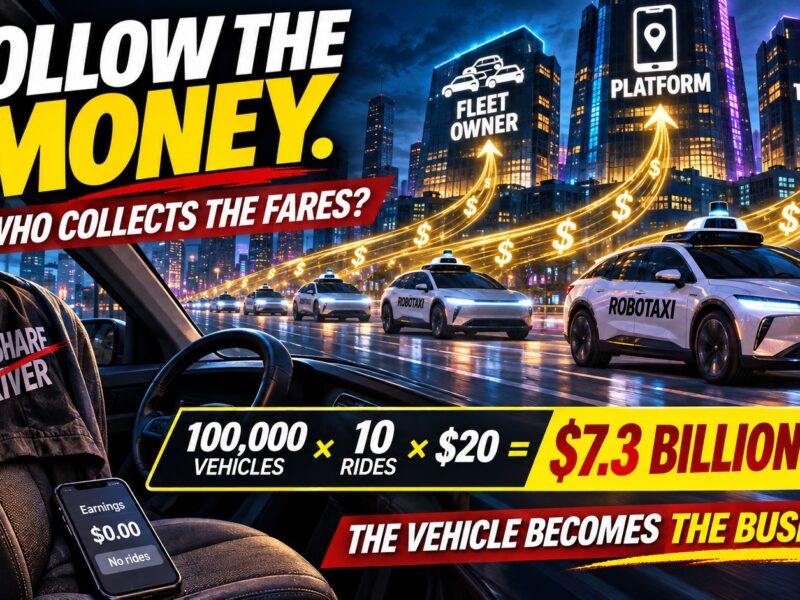
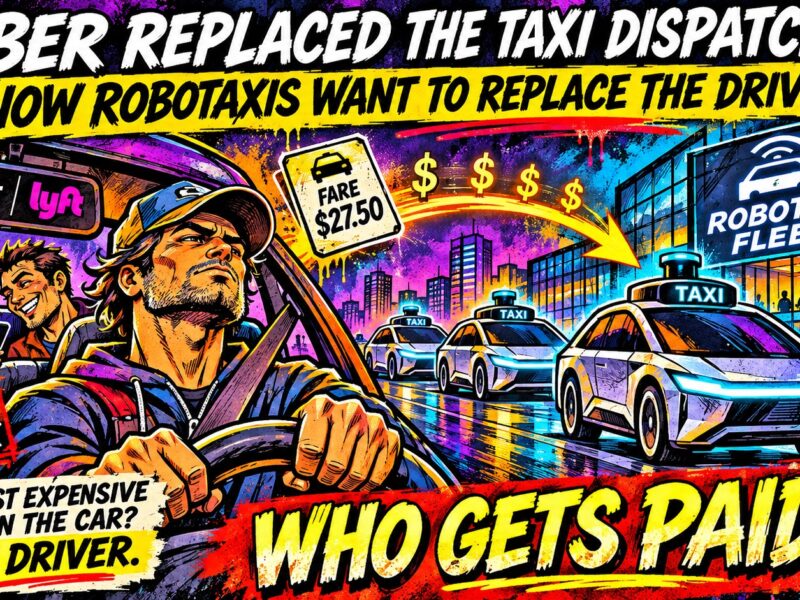
HOW THIS PARKING SPOT GOT STARTED — SIX VIEWS AND A ROBOTAXI! 😂
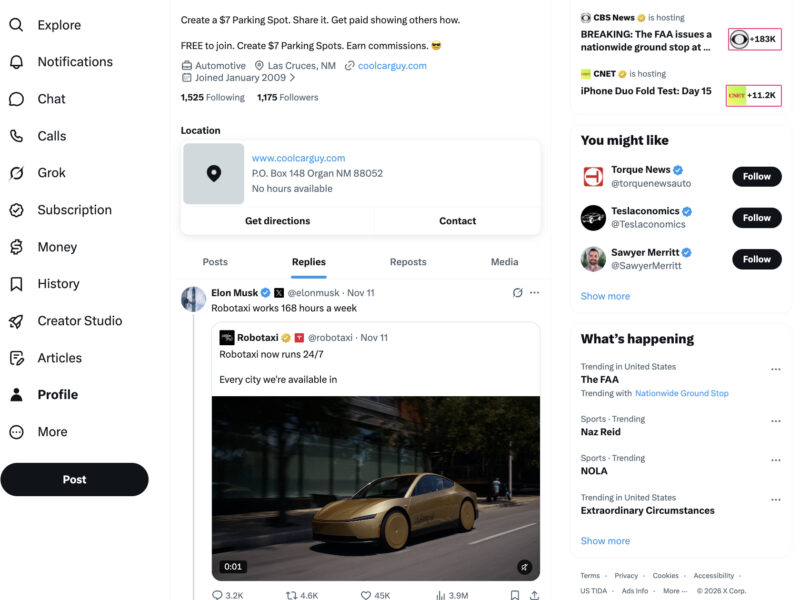
On November 11, 2026, Elon Musk posted something on X that caught my attention.
“Robotaxi works 168 hours a week.”
That’s 24 hours a day, seven days a week! And apparently, we’re all supposed to be celebrating!
But I had a slightly different reaction. I started thinking about the people who earn their living driving for Uber and Lyft.
I have both apps on both of my phones. My wife Becky and I travel quite a bit around the country, and we’ve used both services countless times. We’ve met some interesting and really cool people along the way. People driving their own vehicles, making some money, and sometimes sharing fascinating stories about their lives.
So I responded to Elon’s post with five simple words:
“Uber and Lyft drivers BEWARE!”
That’s it. LOL.
And then something else caught my attention. Take a look at the screenshot I included with the images for this Parking Spot.
Elon Musk’s post: 3.9 MILLION views. My response: SIX views!
SIX! 😂 And I’m actually a PAYING customer on X!
Now, based on my experience posting on X, I have my suspicions about how much reach its algorithm gives my content. Can I prove somebody deliberately throttled this particular response? No. Elon’s post had been online longer, and he obviously has a slightly larger following than I do. LOL.
But COME ON! The irony is hilarious!
Elon is celebrating a Robotaxi that works 168 hours a week, while X has its own collection of robots deciding which conversations get traffic! Apparently, the algorithm didn’t think my five-word response deserved much of a ride.
Maybe X already has its own Robotaxi. Mine just keeps dropping my posts off in the middle of NOWHERE! 🤣
But this got me thinking about something considerably more serious. I started discussing the economics of autonomous transportation with ChatGPT.
Yeah, I know. I’m using an AI robot to help me write about AI robots taking people’s jobs. The irony isn’t lost on me! 😂
And what started as a five-word reply on X turned into a fascinating examination of an industry that could eventually displace enormous amounts of income currently earned by human drivers.
You’ve probably heard people warning that AI is coming for your job. Well, guess what?
Maybe Elon’s company is already coming for somebody else’s!
And that’s what this Cars Freak Parking Spot is about. Not because I believe autonomous vehicles are necessarily bad. I actually think the technology is pretty cool. And not because I believe Elon Musk shouldn’t build them.
But because there’s an enormous economic story developing here that deserves some attention.
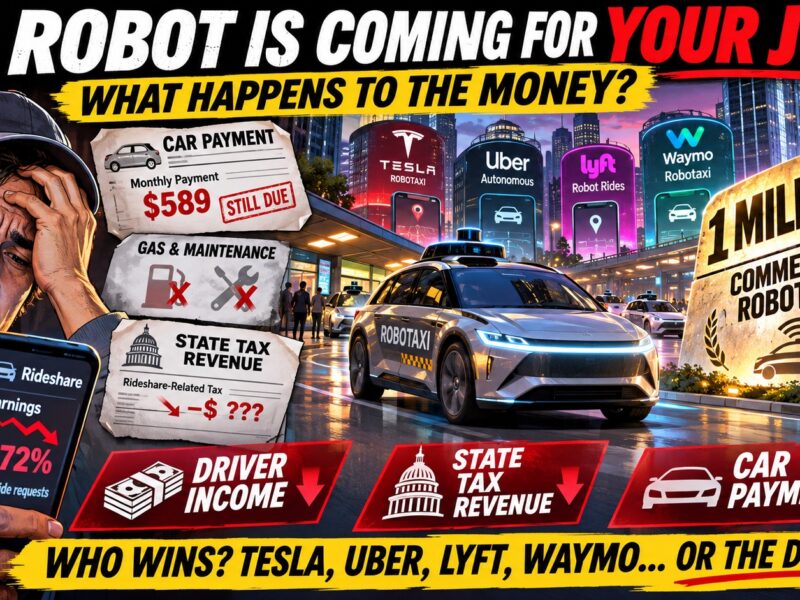
If you earn your living driving other people around, you might want to pay attention because A ROBOT IS COMING FOR YOUR JOB!
Maybe not tomorrow. Maybe not next year. And certainly not everywhere at once. But the business model is already being developed, tested, and deployed.
And the people building your future taxi experience are definitely interested in your MONEY!
NOW, LET’S FOLLOW THE MONEY!
UBER CHANGED THE TAXI BUSINESS. NOW SOMEBODY WANTS TO CHANGE UBER.
Remember when you had to call a taxi company, wait for a dispatcher, and hope a driver eventually showed up?
Then along came Uber. Download an app. Push a button. A stranger shows up in their own vehicle and drives you somewhere.
BRILLIANT!
Uber didn’t need to invent the automobile. It didn’t even need to invent the taxi business. It created a marketplace connecting people who needed rides with people who had cars and wanted to make money. Lyft followed with its own version of the business.
Suddenly, ordinary people discovered their personal automobiles could become little income-producing businesses.
Need extra money? Drive. Lost your job? Drive. Retired but want additional income? Drive. And you could generally decide when you wanted to work.
Of course, there were expenses. Gasoline, insurance, tires, repairs, depreciation, and the occasional passenger who apparently thought your back seat was an extension of the neighborhood bar. LOL.
But the opportunity was real.
I know because when I owned my car dealership, I sold quite a few vehicles to people who were driving for Uber and Lyft. These weren’t theoretical business models to me. These were actual customers buying actual cars, sometimes specifically because they wanted to earn money driving.
And then somebody in the technology business asked a rather uncomfortable question.
“What if we could provide the ride WITHOUT paying a driver?”
Now THAT is an interesting business proposition!
Because the cost of paying people to provide a service is something businesses have been trying to reduce for as long as businesses have existed. And transportation is certainly no exception.
ELON MUSK HAS ENTERED THE CHAT!
On November 11, Elon celebrated Tesla’s expansion of Robotaxi operating hours with that remarkably simple observation:
“Robotaxi works 168 hours a week.”
Tesla says its Robotaxi service is now available around the clock in the cities where it operates. That doesn’t mean every individual vehicle runs continuously without charging or maintenance. But from a business standpoint, the idea is obvious.
While your Uber or Lyft driver is catching a movie, sleeping, having dinner with the family, or deciding whether to turn on the app to earn some extra money, the autonomous transportation system can keep offering rides.
A human driver needs sleep, food, bathroom breaks, vacations, and, most importantly, enough money to make driving worthwhile!
A Robotaxi doesn’t need a paycheck. It needs electricity, maintenance, insurance, cleaning, software, and a rather expensive piece of machinery that had better not run into anything.
That’s not FREE transportation. But it’s a dramatically different business model.
And maybe they’ll put a robot or a blow-up doll in the front seat just to make passengers feel more comfortable having something that LOOKS like a person driving them around! 😂
Imagine ordering a Robotaxi, and the app tells you that your driver is a guy named BOB.
You get in and discover your driver is actually an inflatable mannequin named BOB! 😂
Maybe he can talk? Maybe not.
“How’s your day going, Bob?”
SILENCE.
“Well, at least he’s not asking for a tip!” LOL.
The human driver is no longer necessarily the person supplying the vehicle and earning money from each trip. THE VEHICLE ITSELF BECOMES THE BUSINESS!
Think of it like a Coke machine. You put a machine somewhere, people use it, and the owner collects the money. Except this particular Coke machine can drive around town, pick up customers, and hopefully avoid telephone poles. LOL.
And whoever owns the vehicle, controls the technology, and manages the customer relationship may capture a much larger share of the transportation revenue.
That’s where this story starts getting REALLY interesting.
LET’S DO SOME BILLION-DOLLAR MATH!
Let’s play with some hypothetical numbers. Suppose an autonomous transportation company eventually operates 100,000 Robotaxis. Each vehicle completes just 10 paid rides per day, and the average fare is $20.
That’s $200 per vehicle per day. Multiply that by 100,000 vehicles, and now you’re talking about $20 MILLION per day.
And over 365 days?
$7.3 BILLION IN ANNUAL PASSENGER FARES!
Somewhere, investors are rubbing their hands together and drooling over those numbers. LOL.
Now, before somebody gets too excited, that’s revenue flowing through the system, not profit. There are significant operating expenses, and actual fares and vehicle utilization would vary. Vehicles break down. Batteries need charging. Insurance isn’t free. Fleet operations cost money.
But we’re still talking about billions of dollars in transportation transactions without human drivers collecting traditional driving income from those trips.
That’s a TON of Coke machines!
And now imagine scaling that business toward a million vehicles.
Here’s another question. WHO GETS TO OWN THOSE ROBOTAXIS?
Will Tesla eventually sell autonomous vehicles to individuals who can put them to work earning money? Will companies lease them to fleet operators? Or will the biggest players decide there’s more money in owning the vehicles themselves and keeping the revenue?
I don’t know. But looking at the potential economics, I wouldn’t automatically assume an individual driver will be invited to own a little piece of this business.
Why give away part of the revenue if you can own the machine and collect it yourself?
On the other hand, selling vehicles to outside operators could allow a company to expand without financing every car itself. There are several possible models, and that decision alone could shape an enormous new industry.
WELCOME TO THE NEXT CHAPTER OF AUTOMOTIVE DISRUPTION!
WAIT. DIDN’T FORD GET INVOLVED WITH LYFT?
YES! And this is where the history gets interesting.
Ford and Lyft announced an autonomous-driving partnership back in 2017. Then, in 2021, Ford, Lyft, and Argo AI announced plans to commercialize self-driving transportation.
That particular venture didn’t survive. Argo AI shut down in 2022. Apparently, it was four years too early to catch the AI “Lyft” everybody’s talking about today! 😂
Which demonstrates something else about this industry. Even billionaires can spend enormous amounts of money trying to replace a driver and discover that the driver was doing a pretty complicated job! LOL.
But the larger idea didn’t disappear. Uber has partnered with Waymo to make autonomous rides available through the Uber app. And in its November 2026 earnings announcement, Uber said it expected approximately 700 fully driverless vehicles on its platform by the end of the year, with more than 2,000 expected in 2027.
So we could end up with several competing models. Tesla could operate its own autonomous transportation service. Uber and Lyft could become marketplaces connecting passengers with fleets owned by other companies. Automobile manufacturers could sell vehicles to commercial operators.
And other companies could supply the software, maintenance, charging infrastructure, or fleet management.
Remember, Uber’s original genius was creating a transportation marketplace without having to own every automobile.
What happens when the marketplace decides it doesn’t necessarily need the PEOPLE who own the automobiles either?
Now THAT is a business question!
WHAT HAPPENS TO THE DRIVERS?
Let’s follow some actual numbers.
According to Uber, its platform had approximately 10.8 MILLION monthly active drivers and couriers worldwide during the third quarter of 2026. And Lyft reported that more than ONE MILLION drivers earned over $10 BILLION on its platform in 2025, excluding tips.
Come on. Those are some pretty serious numbers!
Now, that doesn’t mean Robotaxis are going to eliminate 11 million jobs. Some people drive part-time. Some work on multiple platforms. Uber’s figures include delivery couriers, not just passenger drivers. And automated transportation is still expanding from a limited number of markets.
But those numbers demonstrate the enormous amount of economic activity connected to human drivers.
Let’s make this personal.
Suppose somebody finances a $35,000 vehicle specifically to drive for Uber or Lyft. I’ve taken quite a few rides in Teslas that people actually purchased to earn money driving for these services. They’ve got a monthly payment, insurance, maintenance, tires, and maybe a family depending on the money they’re earning.
Then autonomous vehicles begin competing for rides in their city. Maybe the Robotaxi company offers lower fares because it doesn’t have to pay a human driver. Maybe the customer doesn’t care who—or WHAT—is behind the wheel.
What happens to that individual who financed the car?
The car payment doesn’t disappear. The insurance bill doesn’t disappear. And I’m pretty sure the bank isn’t going to accept this explanation:
“Sorry about the payment, but Elon Musk invented a better business model!”
LOL.
Now, some people will adapt. Some might find other work. Autonomous fleets could create jobs involving maintenance, fleet operations, charging, cleaning, remote assistance, and customer support.
Maybe.
Although I think some people are a little optimistic about how many replacement jobs will actually be created. We’re talking about companies investing enormous amounts of money specifically to reduce the need for human labor.
And while somebody still has to change tires and repair vehicles, that doesn’t mean every displaced Uber driver is suddenly getting hired to work in a Robotaxi garage. Not to mention, they’re probably not really looking for that gig! LOL.
Those aren’t necessarily the same jobs, in the same cities, paying the same income.
THAT’S THE ECONOMIC DISRUPTION WE SHOULD BE DISCUSSING!
AND WHAT ABOUT THE STATES COLLECTING TAXES?
Here’s another part of this story that doesn’t seem to get much attention.
When someone earns money driving for Uber or Lyft, that income can generate federal and state income taxes and self-employment taxes. Drivers also spend money on automobiles, gasoline, repairs, tires, insurance, and other services. That spending supports other businesses and creates additional economic activity and tax collections.
As I mentioned, I’ve personally sold vehicles to people who drove for Uber and Lyft. So I’ve seen at least one part of that economic chain firsthand.
Now let’s talk about California.
Under Proposition 22, qualifying Uber and Lyft drivers generally operate as independent contractors rather than traditional employees. So the issue isn’t simply disappearing employer payroll taxes.
It’s what happens when money that previously went to thousands of independent drivers starts moving through corporate transportation fleets instead.
Governments could still collect taxes from those corporations, their employees, vehicle registrations, sales, property, and other business activities. But the mix of taxes and the locations where revenue is collected could change.
And let’s be real. Billionaires and large corporations are pretty good at hiring CFOs, accountants, and entire teams of tax attorneys.
Billy Bob driving for Uber probably doesn’t have a corporate tax-planning department working out of his garage. LOL.
Electric Robotaxis could also change gasoline consumption, potentially affecting fuel-tax revenue. Of course, governments could respond with alternative road-use fees and other taxes.
But my point is that the economics will change, and not necessarily in ways that benefit every state or community.
Now, I’m not exactly losing sleep worrying that California might collect less money. But think about it. If governments depend on income and economic activity generated by human drivers, and that activity shifts to corporations operating fleets of autonomous vehicles, they have some planning to do.
AND GUESS WHAT? SOME GOVERNMENTS ARE ALREADY THINKING ABOUT IT!
In November 2026, lawmakers in Washington, D.C., considered legislation involving autonomous transportation. One proposal included a tax of 7.5 cents per mile on Robotaxis, with a portion of the money intended to help rideshare drivers affected by the transition.
The proposal stalled in committee. But the discussion is already happening.
How do you tax autonomous transportation? How do you protect workers who could lose income? And who pays for the roads when transportation technology changes?
I suspect those questions are going to become considerably more interesting as Robotaxi fleets expand. Especially when state legislators realize that the future of transportation might involve fewer human drivers paying income taxes.
THOSE ROBOTAXIS MAY NOT NEED A DRIVER, BUT YOU CAN BET THE GOVERNMENT WILL FIND SOMEBODY TO SEND A TAX BILL TO! 😂
NOW LET’S TALK ABOUT ELON’S COMPENSATION PACKAGE!
Here’s where the business story becomes especially fascinating.
I’ve written about Elon Musk in other content I’ve created, including my Cybertruck Farewell Encore Tour on CoolCarGuy.com. And whether you like Elon or dislike him, you have to admit that he’s an interesting businessman to watch.
In November 2025, Tesla shareholders approved an extraordinary performance-based compensation package for Musk. The potential value could approach $1 TRILLION if Tesla achieves demanding financial, operational, and stock-market milestones over time.
Remember Dr. Evil in the Austin Powers movie? Mike Myers playing the villain and dramatically demanding:
“ONE MILLION DOLLARS!”
Well, now imagine Elon Musk looking at his Robotaxi operation, raising his little finger, and announcing:
“ONE TRILLION DOLLARS!” 🤣
Because here’s one of the actual operational milestones included in Tesla’s compensation plan:
ONE MILLION ROBOTAXIS IN COMMERCIAL OPERATION!
That’s right. Tesla’s own shareholder materials identify one million commercial Robotaxis as one of the potential performance milestones.
Now, that doesn’t mean Elon automatically gets a trillion dollars for replacing human drivers. The compensation package includes multiple requirements, including enormous market-capitalization targets and other operational and financial milestones.
But it certainly provides an interesting incentive to scale autonomous transportation.
And here’s what fascinates me.
What happens when the financial incentives for billionaires and their shareholders are connected to developing technology that could eliminate the income of people currently doing the work?
Is that technological progress? Creative destruction? The next evolution of capitalism? Or is there a better way for ordinary people to participate in the financial upside?
I’m not suggesting Elon Musk should stop inventing things because somebody might lose a job. Innovation has been disrupting industries for centuries.
But I’m suggesting we should at least recognize who’s collecting the money and who’s assuming the financial risk.
Because those aren’t necessarily the same people!
HERE’S THE PART NOBODY SHOULD IGNORE.
Autonomous transportation could also produce some significant benefits.
If Robotaxis eventually become demonstrably safer, more reliable, and less expensive than human-driven transportation, consumers could benefit enormously. People who cannot drive might gain more independence. Transportation could become more accessible. And businesses might discover entirely new opportunities.
I’ll give you a personal example.
My wife and I live in southern New Mexico, and we sometimes travel through the airport in El Paso, Texas. Now imagine I could summon an autonomous vehicle to take us to the airport instead of driving myself.
No worrying about airport parking. No leaving my personal vehicle sitting in a parking lot for several days. Maybe the Robotaxi ride even costs less than driving and parking.
HEY! I might actually LIKE this business model! LOL.
Of course, somebody operating an airport parking lot might not be nearly as enthusiastic.
OH, LOOK! THERE GOES ANOTHER REVENUE STREAM!
And that’s the fascinating thing about economic disruption. One business opportunity can create another business’s biggest headache.
Some industries shrink. Others emerge. Some consumers save money. Other people lose income.
The challenge is that the people who benefit from technological innovation aren’t necessarily the same people who bear the costs of the transition. And those costs don’t magically disappear because an entrepreneur invented something brilliant.
SO WHO WINS?
Maybe Tesla builds an enormous Robotaxi business. Maybe Uber and Lyft become the world’s largest marketplaces for autonomous transportation. Maybe Waymo or another competitor takes the lead. Maybe human drivers continue serving customers for decades alongside autonomous fleets.
After all, some people actually enjoy talking with a real person when they’re traveling around an unfamiliar city. And personally, I’ve met some pretty cool drivers along the way.
I’m not convinced everyone wants to get into a car and have a conversation with the dashboard. Although, considering how many people already talk to their phones, I could be wrong about that too! LOL.
The future isn’t settled. But one thing is becoming increasingly clear.
THE TRANSPORTATION BUSINESS IS NO LONGER SIMPLY ABOUT WHO CAN DRIVE THE CAR.
It’s becoming a competition over who owns the technology, who owns the vehicle, who controls the customer, and WHO COLLECTS THE MONEY!
Uber helped turn ordinary people’s vehicles into income-producing businesses. Now autonomous transportation could turn fleets of driverless vehicles into competitors with those very same people.
And somewhere tonight, an Uber or Lyft driver might be sitting at home making a car payment online while a billionaire celebrates a Robotaxi service that operates 168 hours a week.
One guy is worried about making his next car payment. The other guy is working toward a potential TRILLION-DOLLAR compensation package!
And we’re supposed to believe this is just another exciting advancement in automotive technology?
Well, maybe it is! But I think there’s a much bigger BUSINESS STORY here. And I think the people whose livelihoods depend on driving deserve to be part of that conversation.
Because a machine doesn’t have to earn a living.
BUT THE HUMAN BEING IT REPLACES STILL DOES!
Now THAT is something worth thinking about.
— The Cool Car Guy 😎